
 Proofreading & Editing

 Academic Editing Services

 Admissions Editing Services

 Business Editing Services
How to Humanize AI Content: A Step-by-Step Guide
AI writing tools can speed up content drafting, but the initial version often sounds generic, repetitive, or robotic. The sentences may be grammatically correct, but the writing can still seem flat, vague, or disconnected from actual readers.
Learning how to humanize AI content does not involve hiding AI usage or deceiving detection tools. It means improving an AI-generated draft to make it sound more natural, specific, and useful. This guide teaches you how to humanize AI content for free by revising wording, rhythm, tone, and examples in your draft.
Why AI Content Often Sounds Robotic
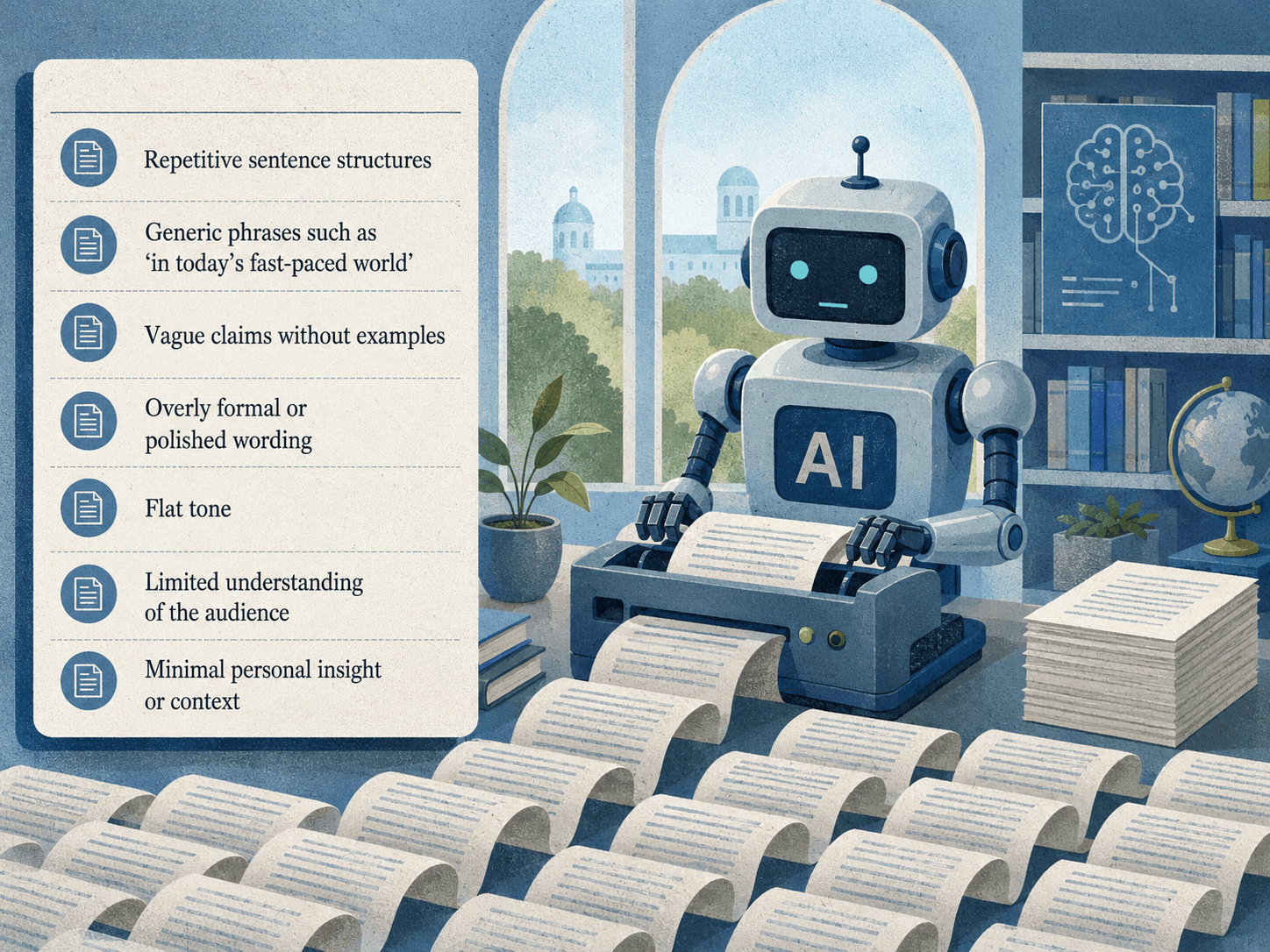
AI-generated writing often sounds robotic due to its reliance on common language patterns. This can generate text that is smooth but predictable.
Typical indicators of AI-sounding content include:
- Repetitive sentence structures
- Generic phrases such as “in today’s fast-paced world”
- Vague claims without examples
- Overly formal or polished wording
- Flat tone
- Limited understanding of the audience
- Minimal personal insight or context
For example:
AI-sounding:
In today’s fast-paced world, it is important to leverage innovative tools essential to enhance productivity.
More natural:
AI tools can speed up the writing process, but human editing is essential for achieving specificity, accuracy, and a natural tone in the final version.
The second sentence is more effective because it is direct, specific, and trustworthy.
How to Humanize AI Content
Making AI-generated content more relatable requires more than just a quick fix or simple rewrite. The best approach is to view the AI output as a draft and revise it step by step for clarity, tone, specificity, and flow.
Step 1: Consider AI Content as an Initial Draft
The first step is to stop treating AI output as completed. AI can help you brainstorm ideas, create outlines, summarize information, and generate a rough draft. However, it does not always understand your audience, purpose, or personal voice.
Before editing, please specify:
- Who is this content for?
- What problem does the reader want to solve?
- Which parts sound too generic?
- Which claims need examples or evidence?
- Does the tone fit the content type?
This helps you move from passive acceptance to active editing. Instead of asking, “Is this sentence correct?” ask, “Is this sentence useful and natural for my reader?”
Step 2: Rewrite Generic AI Phrases into Specific Language
One of the fastest ways to humanize AI-generated content is to remove common AI-style phrases and vague claims. These phrases often sound refined but lack substantial meaning.
| Generic AI Phrase | Better Approach |
|---|---|
| In today’s fast-paced world | State the actual situation |
| It is important to note that | Say the point directly |
| Leverage | Use |
| Delve into | Explain or explore |
| Unlock the potential of | Improve or strengthen |
| Elevate your writing | Improve clarity, tone, or structure |
For example:
AI-sounding:
This comprehensive guide will help you unlock the potential of AI tools.
Humanized:
This guide explains how to edit AI-generated text for clarity, naturalness, and reader usefulness.
The humanized version is more effective as it clearly communicates what readers can expect.
You should also replace vague statements with specific details.
Vague:
AI can improve productivity in various ways.
Specific:
AI can help writers create outlines, summarize lengthy documents, and generate first drafts, reducing the time spent starting from a blank page.
Search for words such as “important,” “useful,” “effective,” “powerful,” and “innovative.” Then ask, “What exactly do I mean?” Add an example, situation, number, or explanation.
Step 3: Vary Sentence Length and Rhythm
AI-generated content typically exhibits a consistent rhythm. Many sentences are similar in length and structure, which can make the writing seem mechanical.
To make AI writing sound more human, vary the rhythm:
- Mix short and long sentences.
- Break dense paragraphs into smaller ones.
- Combine repetitive short sentences.
- Start sentences in different ways.
- Read the draft aloud.
Compare these two versions:
Robotic:
AI tools help writers create content. They improve grammar and structure. They save time. They are useful for many types of writing.
Humanized:
AI tools can accelerate the writing process, especially during drafting. Speed alone is not enough. The final text needs human judgment for clarity, accuracy, and naturalness.
The revised version sounds more natural due to varied sentence lengths and a more logical flow of ideas.
Step 4: Add Human Insight, Examples, or Context
Human writing usually includes judgment. It clarifies the significance, provides examples, or adds context that AI may lack.
To make AI-generated content more human, add:
- A real example
- A personal observation
- Expert judgment
- A practical warning
- A comparison
- Industry-specific context
- A reason why the point matters
For example:
Generic:
AI tools can help students improve their essays.
Humanized:
AI tools can help students brainstorm essay ideas or improve grammar, but they should not replace the student’s own story. In admissions essays, personal reflection and authentic voice often outweigh perfectly polished sentences.
This version is more useful because it adds context and judgment. It also shows that humanizing AI content is not only about changing words. It is about adding meaning.
Step 5: Make the Tone Match the Content Type
Humanizing AI content does not always mean making it casual. The right tone varies based on the writing context.
| Content Type | Best Tone |
|---|---|
| Blog post | Clear and conversational |
| Academic writing | Formal and precise |
| Essay | Personal and reflective |
| Business email | Direct and polite |
| Marketing copy | Natural and benefit-focused |
In academic writing, “human” does not imply informality. It signifies clarity, logic, precision, and strong support. In business writing, this involves eliminating stiff phrases and delivering a more direct message. For blog posts, this may involve using simpler words and a more conversational style.
The goal is not to force one style onto every text. The aim is to align the writing with its intended purpose.
Step 6: Use AI Tools Carefully, Then Edit Manually
AI tools can help you humanize AI content for free or accelerate the editing process, but they should not replace your final review.
A tool like Wordvice AI Humanizer can help rewrite robotic AI text into more natural language while preserving the original meaning, tone, and intent. Thereafter, you can use Wordvice AI Detector to review AI-like patterns and Wordvice AI Grammar Checker to improve grammar, clarity, and sentence flow.
A practical workflow is as follows:
Humanize → Check AI-like patterns → Fix grammar and clarity → Review manually
After using these tools, read the revised version carefully. Check whether the meaning is still accurate, whether the tone fits your audience, and whether the writing sounds specific and natural.
For everyday content, this level of review may be enough. For high-stakes writing, however, it is worth adding one more step.
Step 7: Get Expert Editing for High-Stakes Writing
If you are working on an academic paper, admissions essay, business proposal, or important professional document, AI-assisted editing may not be enough. These documents often need more than natural wording. They also need accurate logic, appropriate tone, field-specific terminology, and consistency across the full text.
Wordvice professional proofreading and editing services can provide human review for academic, admissions, business, and professional writing. This is especially useful when your content requires accuracy, refinement, and suitability for a specific audience.
Example: AI-Generated Text vs. Humanized Text
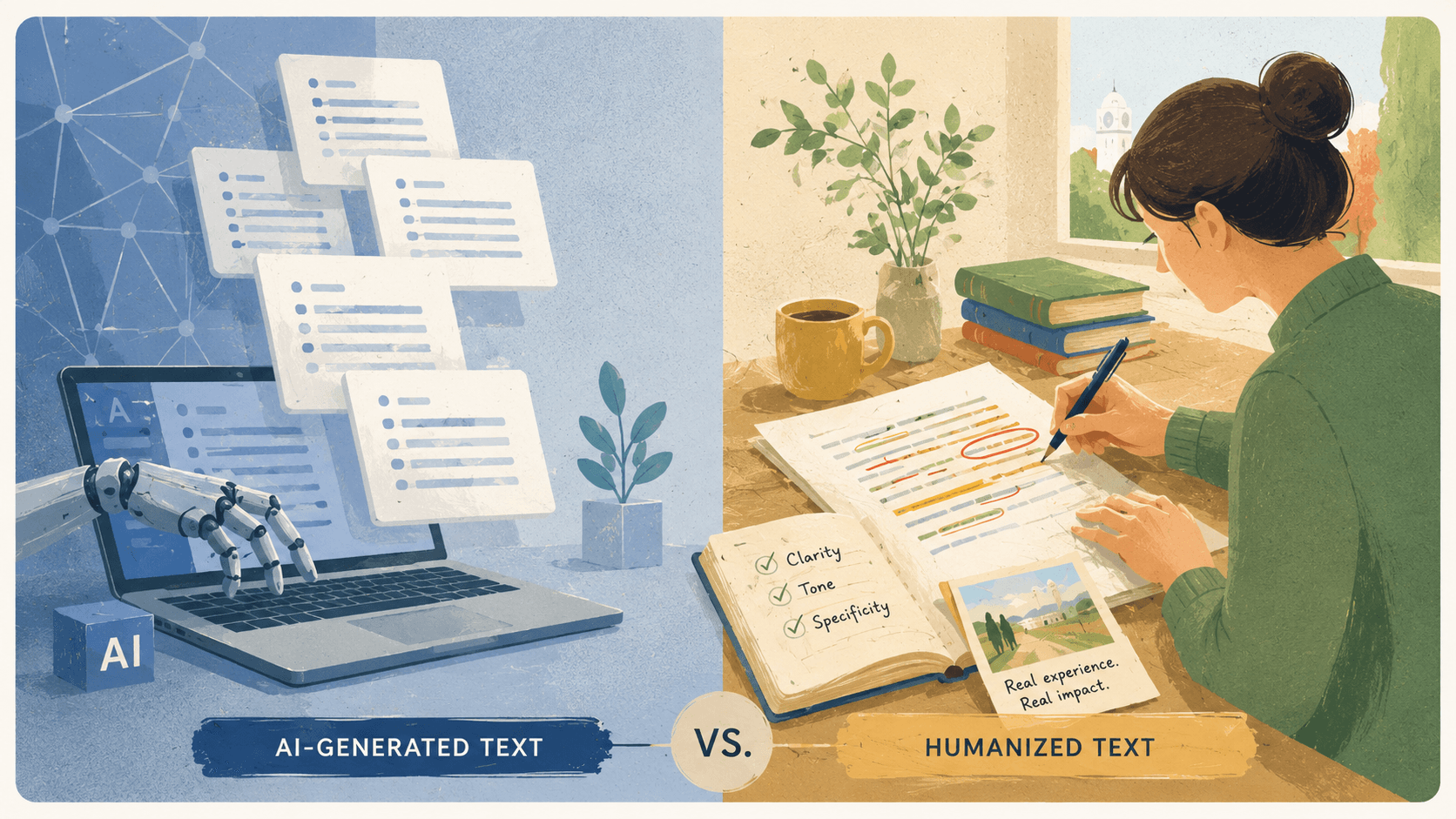
Original AI-generated version:
In today’s fast-paced digital landscape, AI writing tools have become essential for content creators who want to improve productivity and enhance the quality of their writing. These tools can generate high-quality content quickly and efficiently, helping users achieve better results in less time.
What sounds robotic:
- Generic opening
- Vague claims
- Repetitive ideas
- No concrete example
- Promotional tone
Humanized version:
AI writing tools can help content creators quickly move from a blank page to a working draft. For example, they can suggest an outline, rewrite a rough sentence, or organize research notes. However, the draft still needs human editing to make the message specific, accurate, and natural for the intended reader.
This version improves by eliminating generic phrasing, adding examples, and clarifying the role of human editing.
FAQ
What does it mean to humanize AI content?
To humanize AI content means to revise AI-generated text so it sounds more natural, specific, and reader-focused while keeping the original meaning intact.
How do I humanize AI content for free?
Use an AI humanizer when you need a faster first pass to improve flow, reduce robotic phrasing, or compare alternative versions. However, make sure to review the final text yourself for accuracy, tone, and meaning.
Is humanizing AI content the same as bypassing AI detection?
No. The goal is to improve writing quality, clarity, and reader value. It should not be treated as a way to bypass AI detection or avoid disclosure rules.
How do I humanize AI content for academic writing?
Keep the tone formal and precise. Improve logic, terminology, evidence, and clarity while adding your own reasoning and following academic integrity or journal policies.
How do I humanize an AI essay?
To humanize an AI essay, add your own argument, reflection, examples, and transitions. AI can help with structure or grammar, but the essay should reflect your own thinking and voice.