
 Proofreading & Editing

 Academic Editing Services

 Admissions Editing Services

 Business Editing Services
How Do AI Detectors Work in 2026? Accuracy, False Positives, and Why Your Writing Gets Flagged
AI-generated text is now embedded into everyday writing: students draft with it, teams publish with it, and researchers use it to tighten a paragraph last minute. That has made it impossible for educators, editors, publishers, and writers to avoid the question: Was this written by a person, a machine, or some combination?
AI detectors aim to answer this question, but how do AI detectors work, and how accurate are they in 2026? Do they work well enough to identify AI-generated writing, or do they sometimes flag human writing by mistake?
The short answer is that AI detectors can be useful but are not proof of authorship. They search for patterns common in AI-generated text (e.g., predictable wording, unusually consistent structure, and smooth paragraph flow) to flag writing that deserves a closer look but can produce false positives. This article explains how the technology works, how it has evolved, why detectors sometimes flag human writing, and offers guidance on how to interpret false positives responsibly.
Why AI Detection Matters in 2026
AI detection isn't merely a technical issue; it's a matter of accuracy, transparency, authorship, and trust. Writers legitimately use AI to brainstorm, outline, translate, and revise, so the problem isn't AI itself but the undisclosed, unverified content: prose that sounds confident while containing inaccurate claims, fabricated citations, or unsupported arguments. In academic, publishing, and journalistic contexts, readers expect a person to take responsibility for the content.
That's why guidelines from major journals focus on disclosure and oversight. For example, the ICMJE, Elsevier, and Taylor & Francis require authors to disclose which AI tools they used and how and to review AI output for inaccuracy and bias. However, disclosure alone isn't always enough: Writers forget, misread the rules, or ignore them. Detection exists to support responsible writing, not to police every use of AI.
How Do AI Detectors Work?
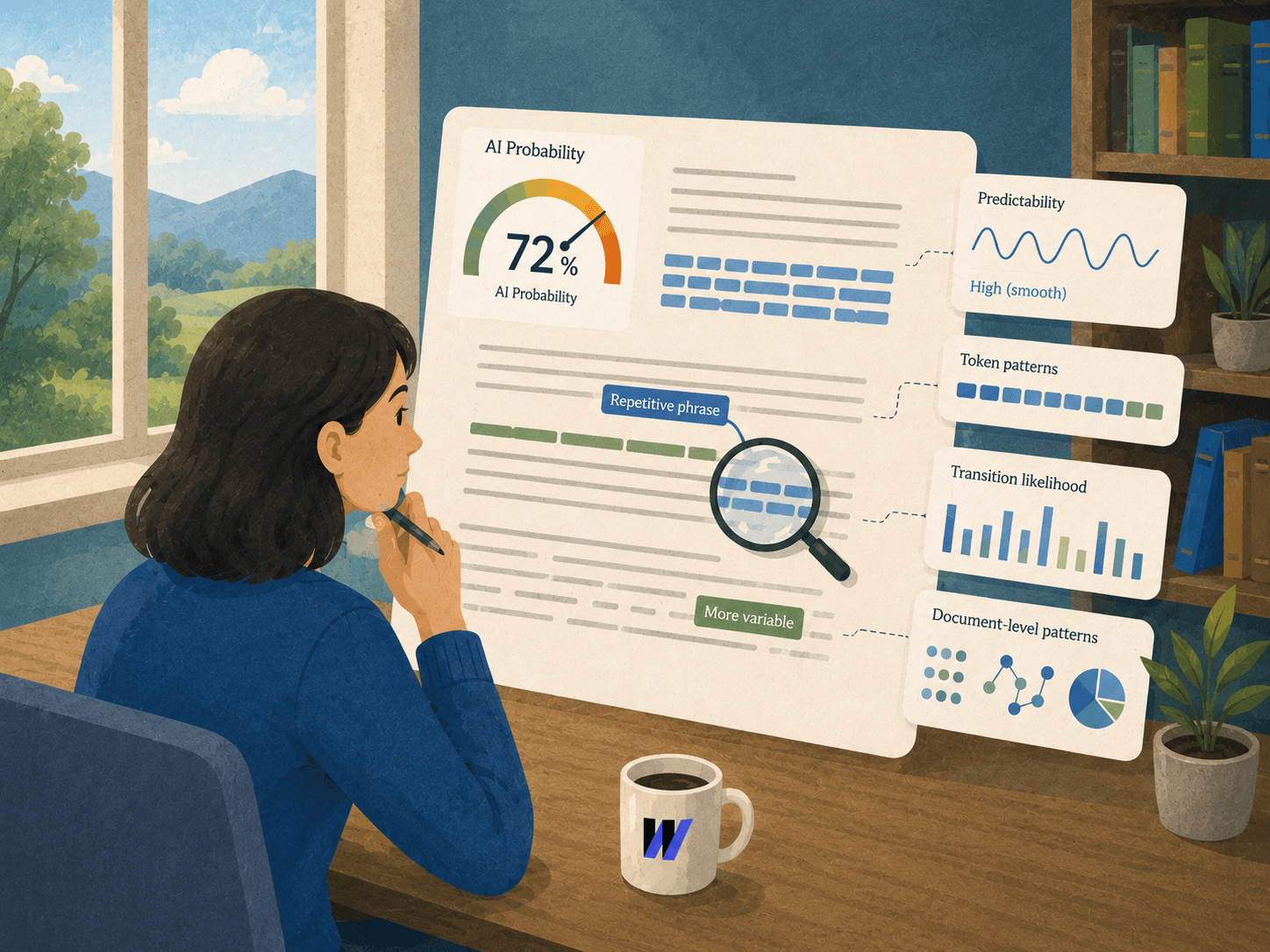
AI detectors don't interpret for meaning; they measure predictability and patterns. Large language models generate text by predicting the next likely tokens, and because they're trained for fluency, their writing tends to be statistically smooth, whereas human writing can be messier, varying in rhythm, sentence length, tone, and structure. Hence, most detectors search for a mix of predictable word choices, low structural variation, unusually smooth transitions, similarity to known AI samples, document-level organization patterns, and watermark signals (when available).
Techniques vary from statistical measurements, trained classifiers, and model comparisons to sentence-relationship analysis and watermark checks, but the goal is the same: determine whether a passage shares patterns associated with AI writing. That's why a score is a probability-based signal, not proof. A high score doesn't indicate someone used AI but that the writing resembles patterns the detector links to it.
How AI-Generated Text Detection Has Evolved
Early detectors relied on statistical clues, such as perplexity and burstiness. Perplexity measures how "surprised" a model is by a piece of text (predictable wording scores low). Burstiness measures variation, which is higher in human writing and lower in AI writing. Early tools such as GLTR (Giant Language Model Test Room) demonstrated that token-predictability statistics could help identify machine-generated text, although these signals often overlap with the characteristics of human writing.
A second approach, supervised classification, trains detectors on labeled examples from human and AI text. These detectors work well when the test sample resembles the training data but struggle when the generator, topic, language, or style changes. Large benchmarks have confirmed this: RAID, a shared benchmark for robust detector evaluation, found that detectors can be fooled by unseen models and rewriting strategies, and the multilingual M4 found that these methods struggle to generalize across new domains and languages.
A later wave of detectors aimed to detect AI text without retraining on every new model. DetectGPT exploits the observation that machine-generated text tends to reside in regions of negative log-probability curvature under the generating model, and Fast-DetectGPT made it more efficient. Newer methods combine signals. For example, Binoculars compared two related models and caught over 90% of the generated samples on its authors' benchmark at a 0.01% false-positive rate without training on ChatGPT data. Although impressive, this result is from specific test conditions and is not a guarantee. Other detectors extend beyond words, such as CoCo (a coherence-based contrastive learning model for machine-generated text detection), which encodes coherence as a graph, reflecting that modern AI text is often too polished for word-level methods alone.
Watermarking and Provenance
Most detectors identify AI text after it's written, whereas watermarking—a hidden signal added during generation—marks content at the source. For instance, Google DeepMind's SynthID-Text embeds a statistical signal into token choices while preserving quality, and a matching detector can later identify the signal without needing the original model. However, watermarking only works when the generating model includes it, and the signal weakens under heavy editing, paraphrasing, translation, or shortening, so detection still requires multiple layers. The wider industry is also moving toward provenance, which tracks where content came from using metadata, cryptographic signatures, or content credentials. In May 2026, Google said it added SynthID verification for images, video, and audio to the Gemini app and was expanding it to Search and Chrome. In addition, OpenAI announced provenance work using Content Credentials and SynthID, starting with images.
How Accurate Are AI Detectors?
Accuracy depends on the text. Detectors tend to perform better on longer, unedited passages from familiar models and less reliably when the text is short, paraphrased, translated, heavily edited, written in a less-supported language, or produced by a newer model on which the detector has never been trained. This is why two detectors can score the same passage differently, based on different training data, thresholds, and reference models.
Accuracy also depends on the risk concerned. A detector can be good at detecting AI text, yet still produce too many false positives, which is particularly serious in academic integrity cases or journal submissions, where a wrong accusation can harm the reputation of a real writer. In practice, AI detection often involves a trade-off between false positives and false negatives: a stricter threshold may catch more AI-generated text but also flag more human writing, while a more conservative threshold may reduce unfair accusations but miss some AI-generated content. The better question isn't simply "Are AI detectors accurate?" but "Under what conditions, for which languages, for what writing type, and at what false-positive rate are they accurate?"
Why Do AI Detectors Flag My Writing? (And What False Positives Mean)
A false positive is when human text is incorrectly identified as AI-generated, one of the greatest concerns in detection. Often, a detector flags writing because it's clean, formal, predictable, or highly consistent. Those qualities appear in both human and AI-generated text. Academic writers use structured paragraphs and standard transitions. Nonnative English writers may use more conventional phrasing. Researchers polish paragraphs until they are smooth, and grammar tools can make prose more regular. Therefore, your writing may be flagged not because the detector has proof, but because your writing shares patterns the detector associates with AI, and it can't see your drafts, notes, sources, or revision history to know otherwise.
False positives matter most for students, researchers, job applicants, and nonnative English writers, for whom a high score can lead to suspicion or unfair accusations if taken as proof. This risk isn't theoretical: a study in Patterns found GPT detectors frequently misclassified nonnative English writing as AI-generated, and Stanford HAI (Human-Centered Artificial Intelligence) noted that detectors can be especially unreliable when the author isn't a native English speaker. Similarly, in Wordvice's submitted research on professionally edited academic manuscripts, some commercial detectors flagged human-written texts from before the LLM era as AI-generated, and professional editing sometimes raised or lowered AI scores depending on the detector. This suggests that some detection tools may respond to style and fluency, not just authorship. The takeaway isn't that detectors are useless; it's that a high score should trigger verification, not deliver a verdict.
Do AI Detectors Actually Work and How Should You Use Them?
AI detectors can work, within limits. They identify patterns associated with AI writing, when there is enough text in a supported language and domain. They can be useful for editorial screening, academic-integrity workflows, and content review. However, they can't prove authorship, determine intent, or tell whether AI use was allowed or disclosed, and they can be wrong.
The best use of AI detectors is as a signal to review, paired with disclosure. A high score should prompt closer review, not automatic punishment. Such a score should result in checking the policy, checking for AI disclosure, examining drafts, verifying citations, and considering whether the style matches the author's usual work. For writers, responsible use includes checking the policy first, treating AI as assistance rather than a replacement for thinking, verifying claims and citations, and disclosing when required (ideally naming which tool was used, how it was used, and which parts of the writing process were affected). For reviewers, the score should be treated as one piece of evidence that supports human judgment, not replaces it. AI detection is best employed to start a careful conversation, not end one.
The Bottom Line
As AI-generated writing has become more fluent and harder to distinguish from human writing, AI detection methods have evolved as well. Modern systems now go beyond simple word-predictability analysis: they use trained classifiers, analyze probability curvature, compare models and document structure, and apply watermarking. Nevertheless, every method is probabilistic, has blind spots, and can make mistakes. AI text isn't automatically inaccurate, but AI content that's undisclosed, unchecked, or presented as fully human-authored creates problems for accuracy and authorship and erodes trust, which is why detection still matters in 2026. The most important rule is simple: An AI detector score is not proof of AI writing; it is a probability-based signal that should be used to guide a responsible review, not replace human judgment.
How Wordvice AI Supports Responsible AI Use
At Wordvice AI, we believe AI detection should be accurate, transparent, and fair to writers. It should not treat all AI use as misconduct but instead help identify AI-generated text that may be undisclosed, unverified, or inconsistent with a specific academic, publishing, or professional context. Because Wordvice has worked with academic writing for over 13 years, including many human-written manuscripts from before generative AI became widely available, we know that polished academic writing can sometimes resemble AI-generated text. For this reason, our AI detector is developed with a strong focus on minimizing false positives, especially in contexts where a wrong flag could unfairly affect a writer. This also means that some AI-generated text may not always be flagged, so detection results should be interpreted as review signals rather than final judgments.
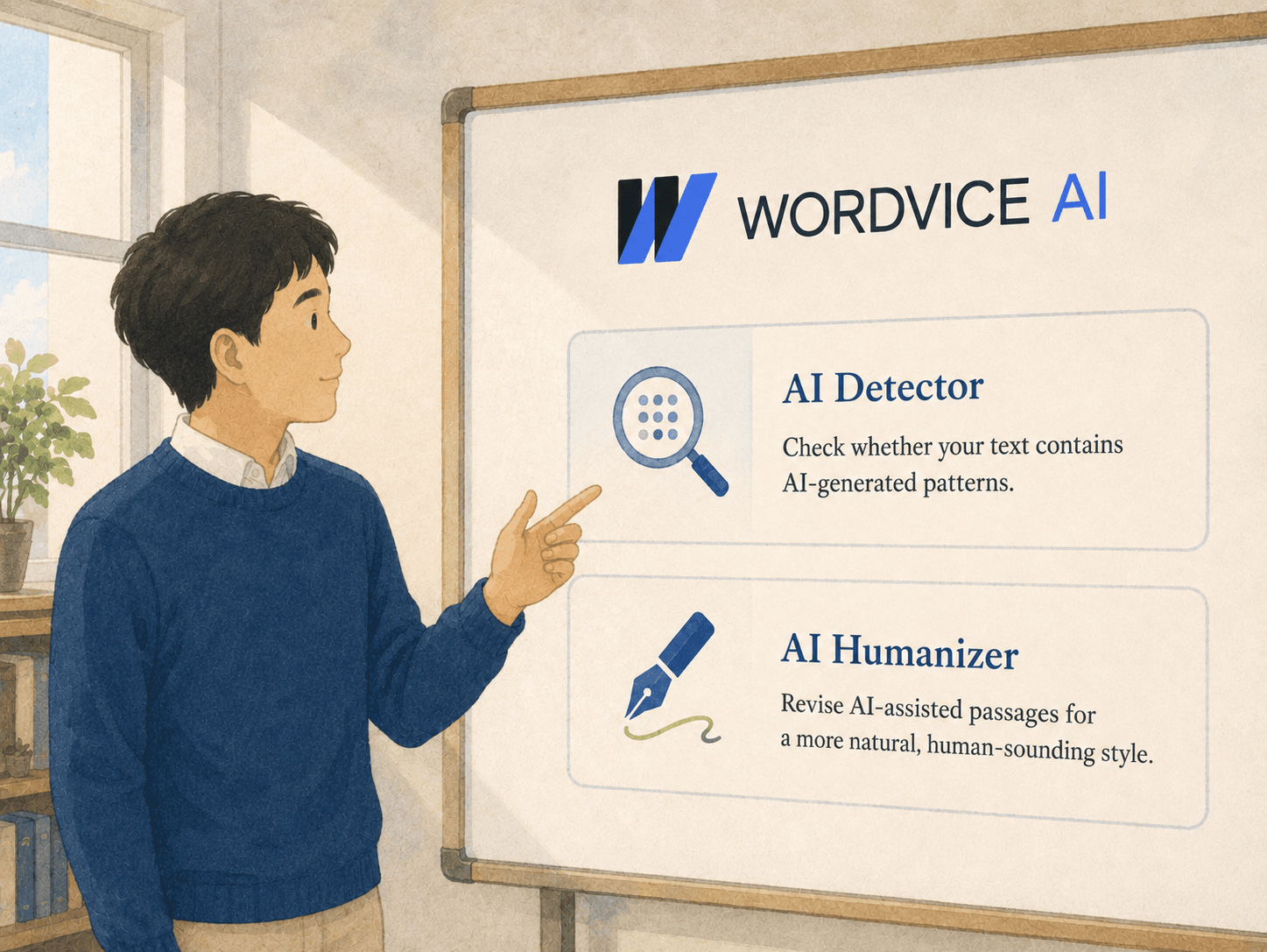
Try the Wordvice AI Detector to check whether your text contains AI-generated patterns, and use the Wordvice AI Humanizer to revise AI-assisted passages for a more natural, human-sounding style.
FAQs
How do AI detectors work?
AI detectors analyze patterns associated with AI-generated text, such as predictable wording, consistent sentence structure, and unusually smooth flow. These scores are probability-based signals, not proof of authorship.
Are AI detectors accurate in 2026?
AI detectors can be useful, especially for longer, unedited text generated by known models, but accuracy varies by language, topic, writing style, editing level, and detector method. The results should not be considered perfectly reliable.
Why did an AI detector flag my writing?
A detector may flag human writing if it is very polished, formal, predictable, or structurally consistent. Academic writing, nonnative English writing, and heavily edited text can resemble AI-generated patterns.
Can AI detectors prove that text was written by AI?
No. An AI detector score can indicate that text resembles AI-generated writing, but it cannot determine who wrote it or whether AI use was allowed, disclosed, or reviewed.