
 Proofreading & Editing

 Academic Editing Services

 Admissions Editing Services

 Business Editing Services
AI Proofreading for Research Papers: How to Improve Graduate Research Papers
Finishing the first draft of your English research paper can bring a unique blend of relief and anxiety. You've checked your findings and your argument multiple times, but the moment you're about to send the manuscript to your advisor or co-authors, every single English phrase suddenly demands a second look.
"Is this sentence grammatically correct?"
"Does this phrasing sound natural in a research paper?"
"Am I repeating the same expressions too often?"
If English isn't your first language, you may spend a significant amount of time reviewing your sentences apart from your actual research content. This is where an AI proofreader can help: it swiftly highlights overlooked grammatical errors and awkward phrasing, giving your draft a first pass before it reaches your advisor.
That being said, blindly accepting every suggestion from an AI proofreader isn't the best approach to academic proofreading. You, as the researcher, ultimately understand your work better than any tool.
This article explores how a first-time graduate student can effectively use an AI proofreader for academic writing at each stage of drafting a paper, using the Wordvice AI Proofreader as a key example.
Step 1. Check Your Paper's Content Before Handing It to an AI Proofreader
Finishing a draft doesn't imply that you should immediately submit the whole manuscript to an AI proofreader.
There are things you need to check yourself first: Is your research question and core argument well-defined? Does your Methods section include all necessary details? Are the numbers and data in your Results accurate? Does your Discussion avoid overinterpreting the findings?
At this stage, the focus should be on ensuring that the research content itself is thoroughly organized rather than refining the language.
An AI proofreader for graduate students is useful for refining grammar and phrasing. However, it should not be used as a tool for evaluating the accuracy of your findings or determining the core argument of your paper. If you fine-tune sentences while the content and structure are still improving, you may end up repeating the same editing work every time you rewrite a paragraph.
Therefore, it's best to start AI-assisted proofreading once you've reached a state like this:
- The main content and structure of the paper are reasonably settled.
- You've checked your tables, figures, and key numbers.
- You've clarified your core terminology.
- No major paragraph additions or deletions remain.
- You want to polish the English once before sharing the draft with your advisor or co-authors.
This is the point where a research paper AI proofreader can genuinely help.
Step 2. Set the Document Type to Academic and Check Your Draft
When using the Wordvice AI Proofreader, you can first select the Document Type that matches your writing.
If you're reviewing a research paper or thesis, choose the "Academic" style. General writing and academic papers differ in vocabulary, tone, and phrasing, making it important to align the style with the nature of your document.
You can also select the editing intensity.
The Wordvice AI Proofreader offers four editing modes:
- Light: Focuses on basic issues such as grammar, spelling, and punctuation.
- Standard: Fixes basic errors, enhances word choice, and improves awkward or unclear phrasing.
- Intensive: Actively refines phrasing and sentence structure to improve readability and flow.
- Concise: Shortens unnecessarily long phrasing and tightens sentences while preserving the original meaning.
If you're reviewing your initial paper draft, beginning with the Standard mode is a smart choice. It looks beyond grammatical errors to catch awkward phrasing as well, all while limiting the rewrites of your sentences to a minimum.
Once your revisions are mostly complete and you're doing a final check before submission, consider switching to Light mode to identify any remaining basic errors.
What matters isn't which mode is "the best," but choosing the editing intensity that matches the amount of revision your current draft actually needs.
Step 3. Don't Just Look at the Revised Sentence—Check Why It Was Revised
To maximize the benefits of an AI proofreader, it's important to develop the habit of checking the reasons behind a suggestion, rather than merely noting the changes made.
The Wordvice AI Proofreader highlights problematic phrasing directly in your sentences and shows you both the type of issue and the suggested fix.
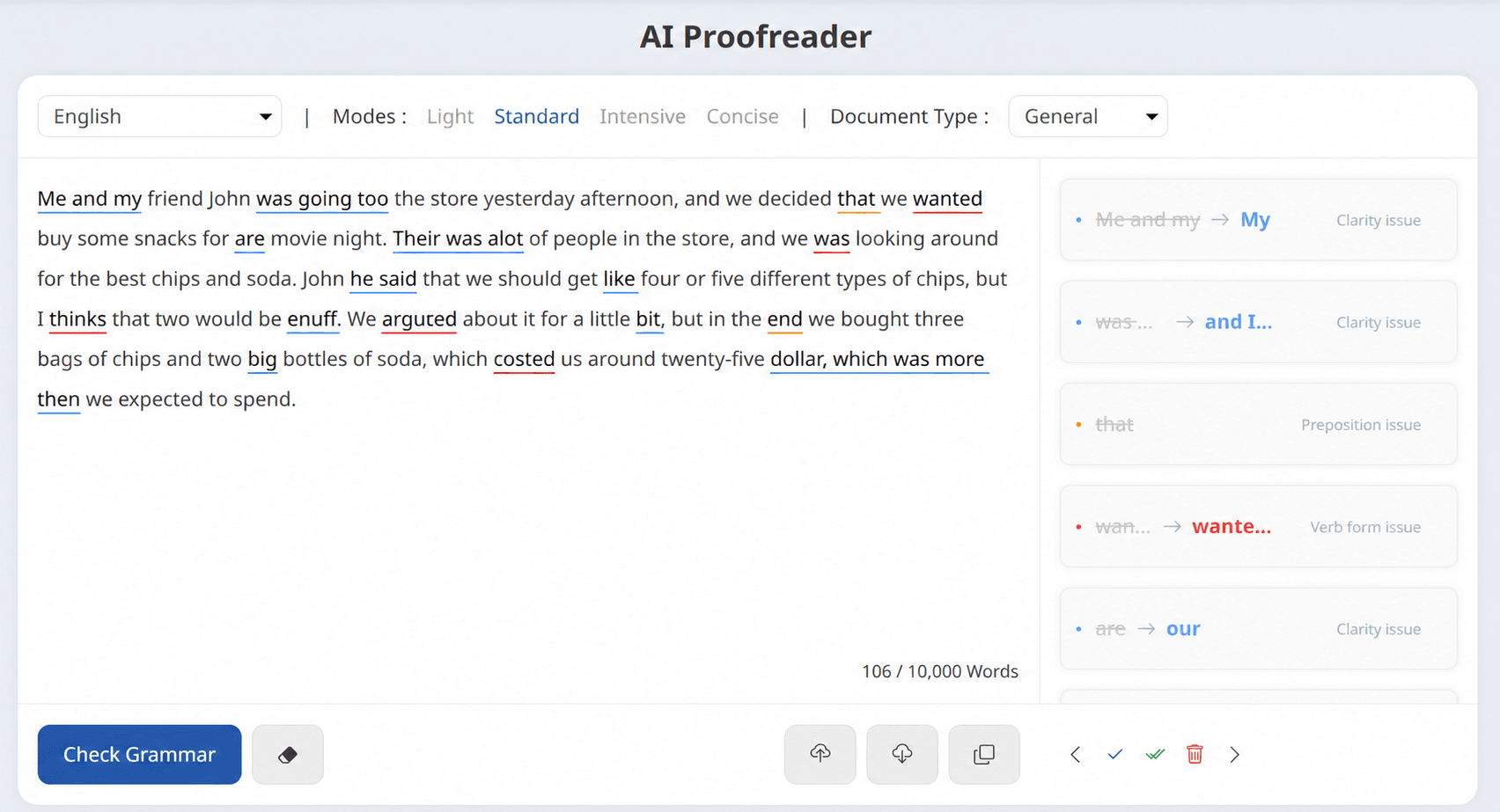
For example, in the screen above, you can see several types of revisions flagged in the original text:
- Clarity issue: The meaning comes through, but the sentence can be phrased more naturally and clearly.
- Preposition issue: A grammatical issue involving articles, prepositions, or similar elements.
- Verb form issue: A verb form that doesn't fit the context, or a related grammar issue.
The advantage of this approach is that it doesn't stop at "this was wrong, so it's fixed."
By checking the reasons behind each revision as you accept suggestions, you can start noticing patterns—the specific phrasing or grammatical mistakes you tend to repeat. This simplifies the process of identifying and resolving similar problems on your own during your next writing endeavor.
Rather than treating AI proofreading for research papers as a tool for correcting mistakes, it's more useful to view it as a way of examining and enhancing your own academic English.
Step 4. Don't Accept Every AI Suggestion
Just because an AI proofreader suggests a revision doesn't mean you need to accept every single one.
Common grammatical errors often come with straightforward suggestions for evaluation. However, in a research paper, even a small wording change can significantly alter the meaning of a sentence.
The following areas deserve particularly careful attention:
Technical terminology
If a term has a specific meaning in your field, replacing it with a word that "sounds" more natural can actually make the sentence less accurate.
Findings and figures
Even when the AI smooths out a sentence, you need to carefully verify that numbers, units, comparisons, and statistical results match the original.
Causality and the strength of your claims
"Is associated with" and "causes" don't mean the same thing. If your findings only show a correlation, but the revised sentence implies causation, you shouldn't accept it just because it reads more smoothly.
The emphasis the author intended
While tightening a sentence, an AI proofreader may unintentionally remove a condition or limitation that you intentionally highlighted.
This is why an AI proofreader is best used not as the final decision maker, but rather as an additional reader.
The AI identifies issues you may have missed and offers alternatives. As the author, it is ultimately your decision to determine whether that alternative truly maintains the integrity of your research.
Step 5. Re-check the Consistency of the Entire Paper, Not Just Individual Sentences
When you're fixing grammatical errors one by one, it's easy to focus only on individual sentences. However, in a research paper, consistency across the entire manuscript equally matters.
Once your AI proofreading pass is done, revisit these points:
Is your terminology consistent? Check whether the same concept is described with one term in one paragraph and a different term in another.
Is your tense used appropriately? Check that tense is consistent and appropriate in the sections describing your methods, results, and citations.
Are your abbreviations consistent? Check that you have spelled out the full term the first time an abbreviation appears and that you maintain consistent use of the same abbreviation thereafter.
Do the key terms match between your Abstract and the body? Check that the core terms describing your purpose, main variables, and findings aren't used too differently in the Abstract versus the body text.
Are American and British English mixed together? If your target journal has a house style, maintain one spelling convention throughout the entire manuscript.
This step is still necessary even after you've addressed every issue the AI flagged. A collection of individually error-free sentences doesn't automatically add up to a consistent paper.
When Is It Actually Beneficial to Use an AI Proofreader?
You don't need to keep running an AI proofreader for research papers throughout every phase of the writing process. It's actually more effective to set specific checkpoints for using it.
The first is right after you complete drafting a section. After writing a section such as the Introduction or Discussion, where lengthy sentences and logical coherence are crucial, you can clean up any basic grammatical and phrasing issues.
The second is before sending your draft to your advisor or co-authors. Clearing out simple grammatical errors and awkward phrasing before receiving feedback lets them focus on the core content of your research rather than the language.
The third is when reviewing a revised manuscript. After incorporating feedback from co-authors or your advisor, you can double-check whether any new errors have crept into the newly written sentences.
Finally, you can use it for a final check before journal submission. At this stage, the focus should be less on major rewrites and more on identifying any remaining basic language concerns and ensuring consistency throughout the text.
AI Proofreading Alone Doesn't Finish the Job
As AI proofreading tools have improved, researchers can now review far more of their own English drafts independently. An AI proofreader is especially useful for quickly checking the kinds of things you need to verify repeatedly—grammar, spelling, punctuation, and awkward phrasing.
However, good academic writing isn't complete just because every sentence is grammatically correct.
As the author, it is your responsibility to ensure that your intended argument is stated correctly, that the strength of your wording matches your findings, that the terminology specific to your field is used correctly, and that the logical transitions smoothly from one paragraph to the next. Only you can confirm these elements.
That's why the best way to use an AI proofreader isn't to hand off your paper for it to fix on your behalf, but to use it as a tool that helps you review your writing more thoroughly.
Five Things to Check Before Sending Your Draft to Your Advisor
If this is your first time drafting an English research paper, do one last review against these questions:
- Have you thoroughly checked for grammar, spelling, and punctuation errors?
- Did any of the AI's revisions change your original research content or meaning?
- Are your terminology and abbreviations used consistently throughout the paper?
- Does the writing maintain the clear, objective tone expected in academic papers?
- Do the key terms and claims in your Abstract match those in the body text?
Once you've confirmed these five points, you're ready to share your draft with your advisor or co-authors and get feedback on your research.
When writing your first English research paper, you don't need every sentence to be perfect from the beginning. Start by making your research content easily understandable, then use a tool such as the Wordvice AI Proofreader to check your draft's grammar and phrasing systematically.
Reviewing and judging the AI's suggestions yourself is what actually transforms AI proofreading for academic writing into a genuinely useful part of your writing process, rather than a replacement for it.